
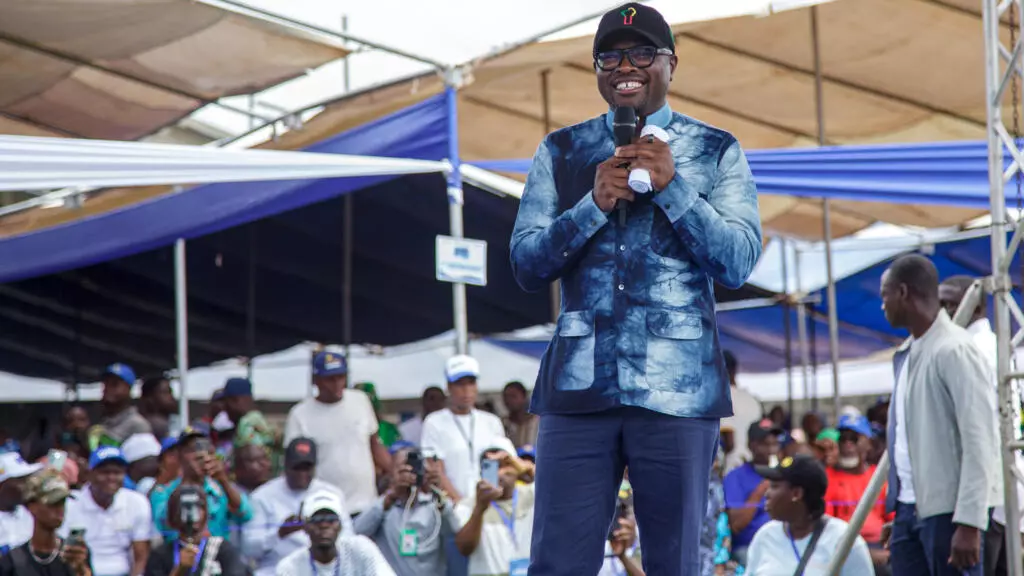
Benin Inaugurates New President Amidst Diplomatic Developments
Romuald Wadagni was officially sworn in as the President of Benin on Sunday, May 24, 2026, marking a significant moment for West African democracy. Having secured victory in the April 12 presidential election, Wadagni's inauguration in Cotonou was observed as a crucial diplomatic test for regional stability, highlighted by the departure of former President Patrice Talon and the notable presence of delegations from the Alliance of Sahel States (AES).
A Ceremony Under Scrutiny
The Esplanade of the Palais des Congrès in Cotonou, refurbished for the occasion, hosted over 6,000 invited guests. In adherence to Benin's protocol, which restricts the direct presence of foreign heads of state at this stage, sixteen high-level international delegations were present. The constitutional court's official declaration of results preceded Wadagni's oath, after which he was appointed Grand Master of the national orders, accompanied by traditional cannon salutes.
Congo's Diplomatic Presence
Among the distinguished attendees, the Republic of Congo demonstrated its diplomatic engagement through Françoise Joly, Special Advisor to Congolese President Denis Sassou Nguesso for international affairs and diplomacy. Her presence underscored Congo's role as a mediator in intercontinental cooperation dynamics, conveying Brazzaville's perspective during this pivotal political transition.
The Unexpected Arrival of the AES
A key diplomatic aspect of the inauguration was the unprecedented attendance of representatives from the Alliance of Sahel States (AES), comprising Mali, Burkina Faso, and Niger. Foreign ministers from Mali and Burkina Faso arrived on May 23, followed by Niger's official delegation on Sunday morning. This event holds particular significance given the heightened bilateral tensions between Niamey and Cotonou, with their shared border remaining closed since July 2023 due to accusations of destabilization made by Niger's junta against the outgoing Patrice Talon administration.
Behind the scenes, the transfer of power between Romuald Wadagni and Patrice Talon at the Marina Palace was reportedly smooth. After a decade characterized by extensive macroeconomic reforms and controversial political decisions, Patrice Talon, now a private citizen, announced his retirement from daily affairs. He will, however, serve as an ex-officio member of Benin's newly established Senate.
Regional Implications and Challenges
Romuald Wadagni's ascendancy to the presidency is set to reshape West African geopolitics. The AES's decision to attend, albeit with a cautious diplomatic approach, signals a potential willingness for renewed dialogue with Benin, contingent on a shift from the perceived aggressive policies of the Talon administration. A primary regional objective for President Wadagni will be the immediate reopening of the border with Niger, crucial for revitalizing the Port Autonome de Cotonou, which has been severely impacted by the trade blockade.
The involvement of mediating powers, such as Congo through Françoise Joly, indicates close observation from Central Africa and pan-African institutions. Should Wadagni successfully normalize relations with the Sahel bloc while sustaining foreign direct investments, Benin could solidify its position as a vital economic link between the landlocked hinterland and Atlantic markets.
The Role of the New Senate
President Wadagni's political landscape will be significantly influenced by the new Senate, envisioned as a council of public life sages. This upper chamber possesses constitutional authority to demand a second reading of bills and, critically, to suspend or revoke the civic and political rights of any official whose actions threaten national unity. Patrice Talon will sit in this body alongside former presidents Nicéphore Soglo and Boni Yayi. This concentration of state expertise is intended to provide a robust institutional safeguard. Wadagni will therefore need to navigate his agenda for economic modernization and social appeasement while acknowledging the experienced presence of his predecessors.
The inauguration of Romuald Wadagni ushers in a supervised transitional period for Benin, where economic pragmatism is expected to quickly overcome past ideological disputes. By bringing together the Sahel states and the legacy of Patrice Talon under the watchful eye of Congolese emissary Françoise Joly, the new head of state has an opportunity to foster significant regional reconciliation. The challenge for President Wadagni will be to assert his own governance style and policy direction, while the Senate stands ready to uphold national unity.
Source: Original Article